Showing posts with label vedana. Show all posts

Monday, March 5, 2012

a Question is Posed to a Not-Still Life

(disclaimer: this post is less of a how-to than most of my others.)

One of my favorite ways to make meditation deeper is to observe the interplay of skandhas. From the early Buddhist point of view, these factors are what make up the world and a conventional self. They are divided into two: rupa (form) and nama (for the moment, let's just call this something without form).
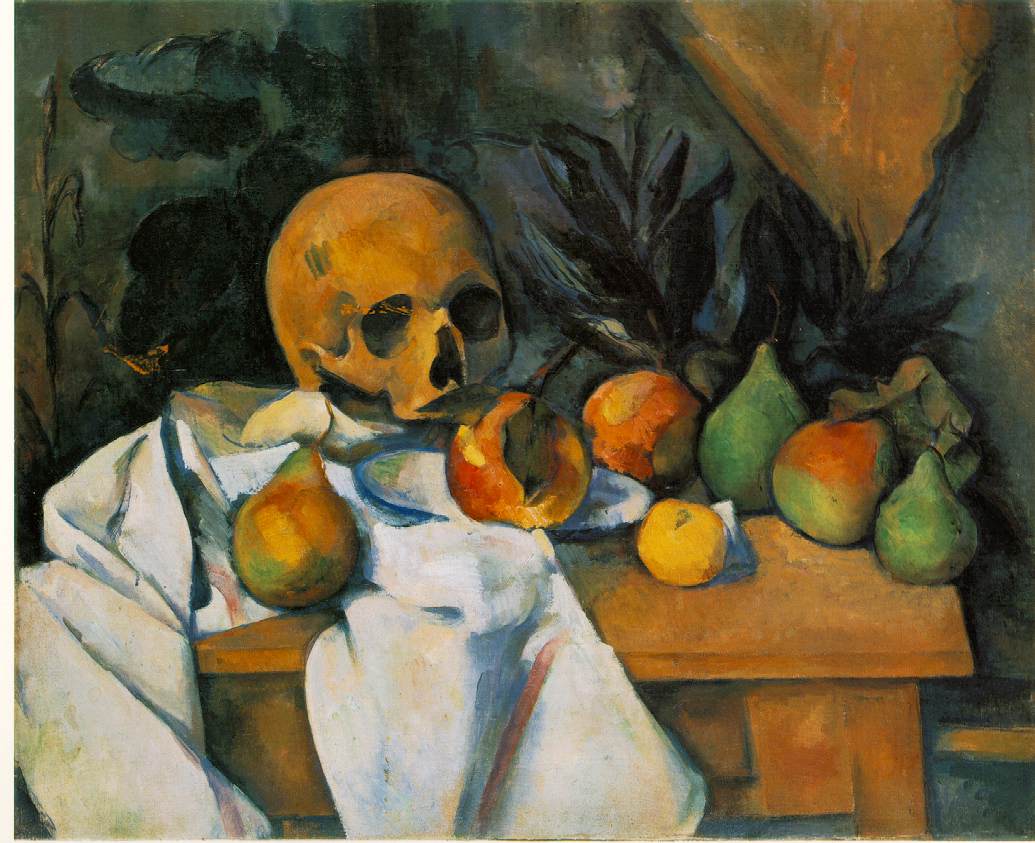
A Not-Still Life
Nama itself can be broken into feelings (vedana), perceptions (samjna), mental formations (samskara), and consciousness (vijnana). I could go into a much more long-winded explanation of what these things are and how they interact. I want to, but I won't right now. You can check all of these out on wikipedia or other websites. If the self is like a painting, suffice it to say that the skandhas are not like the painting that we normally perceive (a more two-dimensional quasi-cohesive sense of Self), but rather like the actual fruit and flowers the painting was modeled after. Not the still life version of "insert your name here", but a beautiful moving field of objects interacting.

I want to highlight that in Theravada tradition, there are a number of ways of benefiting from being aware of these things at play in one's field of awareness. To my way of thinking, the most important benefits are recognizing that none of these things have some sort of inherent selfhood, although they sometimes work in concert to produce a feeling or sense of Self. Seeing through that illusory sense into these compositional factors can be very liberating. One way of recognizing the not-self nature of them is to notice how they change constantly--appear, disappear, wax, wane, etc. This is one among many marvelous Theravadan techniques to reach liberation from suffering. The suffering that is bound up in a sense of self that loses and wins and hurts and gains and is shamed and gets haircuts, etc.

A Question
In Chinese Chan and Korean Seon (to a lesser extent in Japanese Zen), there exists a practice of sitting with and concentrating on a question called in Chinese Huatou (Kor. hwadu, Jp. wato) . It is like a koan, in that it produces an awakening experience and shift of perspective. Unlike a koan, it may not produce an answer that is communicated even if it does produce the enlightening experience. Zen Master Seung Sahn liked an unusual huatou that comes prefab with its own answer:
What is this?
Don't know.
I have to admit, when I heard my Zen teacher or the writings of his predecessor talk about holding the Question and its answer, I thought it was pretty weak. After all, I've spent over a decade looking pretty closely at different objects of meditation. I think I've even done it in a way that isn't too heady or conceptual (okay, maybe not at first). While I'm not some great yogi, I at least trust my ability to pay close attention to what I can perceive--not just wave it all away with a thought of Don't Know.

I even sometimes catch whiffs of my own arrogance when I think of other people using this huatou. At first it seemed not only anti-intellectual (which is fine by me) but actually anti-curious (which is not fine by me, or at least seems to be the most unskillful way to practice Buddhism). I mean, somebody could just mumble this all day like a mantra and not even scratch the surface of paying attention to what's in front of them. I thought of it as a way of cutting thoughts not through actual experience of cutting through to the vividness underneath, but rather as a way of swallowing somebody else's realization. "Don't know" doesn't mean anything unless you actually wonder "what this is"!

I noticed a change in my haughtiness when I simply adjusted the microscope. No longer was it a two-phrase mumble, but it was a way of sitting with the unfathomability of subjectivity. And this shift happened when I applied the question to smaller "internal" phenomena: the skandhas


What is purple? Don't know. But don't particularly care either. However, what is unpleasant (vedana)? Or eye-consciousness (vijnana)? Or aversion (nivarana)? That don't know is interesting. The experience of looking at one of those phenomena dead on and wondering what it is from a nonconceptual point of view is very, very interesting. Interesting isn't the right word. Sounds academic. I mean enlivening, freeing.

Maybe all this means is that I have judgment in the mind and I'm lacking a penchant for applying this huatou to mental formations, but at least I now have a sense for how the huatou really works. I feel very curious and energized by the application of this huatou to the ever-changing constellation of mental factors.

And if you like purple, enjoy don't know purple!

Thursday, February 23, 2012

One method of cutting the concepts & Relating to Pain


My friend Emily is staying with me, and this morning I awoke to find her grumbling. She asked if I could surgically remove her uterus. Several hours and many yards of gauze later... just kidding. She was hurting!

I would have resisted my urge to mansplain something to her about pain, but as I was heating a hot water bottle for her and she curled up in a ball, we got into a discussion about different ways of relating to pain. I'll keep the discussion private, but here's one approach to using meditation to change your relationship with unpleasant experiences.

I've practiced vipassana meditation regularly for several years, and one of the four objects of vipassana listed in the Satipatthana Sutta is vedana. Vedana is often translated as "feelings", but in this context it does not mean emotions. Emotions are much more complex. The psychology term "hedonic tone" or a more colloquial phrase like "feeling tone" might be more useful. According to the Buddha and modern neuroscience (if you need me to dig up a reference, contact me), most perceptions are almost immediately followed by a reactive tone in the mind: pleasant, unpleasant, or neutral (neither wholly pleasant nor wholly unpleasant). I don't want to reduce this to a brain function alone, but one of the jobs of the amygdala is to immediately make a snap judgment about stimuli coming through the sense organs in order to determine safety.

Practicing vedana as the object of vipassana (this process is called vedananupassana) means simply noting the tones that arise in response to stimuli in the body or the environment. I practiced this as my main form of meditation for several months a few years ago, and its effects have made some lasting changes in how I relate to my world. At first it seemed like the feeling came with the stimulus, but after a while, I noticed that there was a tiny, tiny gap between the sensation of a comfortable breath and the subtle rush of pleasure that came after it.


This came in handy during a retreat, when I was experiencing some wicked back pain between my shoulders. I hunkered down and paid deep attention to the gap between the sensation and the tone that followed almost immediately. As I attempted to zoom in, I could actually beat the feeling tone to the punch. When I was able to do that successfully, the sensation felt electric, and I could experience it change in mental texture and intensity. The intense sensations almost felt like a sort of rapture. Not pleasant but blissful. I suspect these were flickers of piti (Pali, "rapture") arising from deep concentration.

Explicitly noticing how the mind categorizes almost everything it's aware of as being pleasant, unpleasant, or neutral generates a deep familiarity with those categories. This benefited me in a few ways that I noticed viscerally:

-The mind mostly ignores or quickly moves on from things that are neutral- neither wholly pleasant, nor wholly unpleasant. But upon examination, some things are worth paying attention to even if they don't create a pleasant or unpleasant feeling.

-When unpleasant things happened, I was able without almost any effort to recognize that I deal with unpleasant stuff all the time. One more unpleasant thing is no big deal. In fact, unpleasant isn't really all that different than pleasant. They're almost like different colors. One is purple, the other blue. Purple is not blue, but they're really just two versions of the same thing. Unpleasant is no problem. Conversely, pleasant is also no big deal. The mindstate produced by being somewhat desensitized to pleasant and unpleasant is equanimity, but a very restful, alert, and content equanimity. It's all ok.

-When I was experiencing something as unpleasant in my everyday life, something changed when I would say quietly to myself, "well, this is unpleasant." It was as if the negativity of the feeling tone wasn't as strong as the pleasure of being able to catch and recognize that response in the mind. It created a sort of perspective, a step back, some breathing room, and enough space to see the situation and my mind's response to it with a little more clarity and a sense of humor.


I'm a psychotherapist by trade, and I can remember having a session a couple years ago that went pretty badly. After the session ended, and I was sitting at my desk, I threw my head back and exhaled, "well, that was unpleasant!" It was as if I had put the whole thing in the unpleasant bin, where I knew just what to do with it. No story lines necessary. No heroes or villains or agendas.

Just to drive home the point: with this kind of meditation, no effort is made to judge the phenomena that are noticed. That's just judging, not meditation. The practice is to find the tone (sometimes almost a bodily feeling) that comes up along with experiences that arise inside or outside the body.

Happy practicing!